Most trivia formats test recall. Timeline trivia does something more interesting: it asks viewers to compare, guess, and place events in order.
That small shift changes the entire experience. Instead of a knowledge check, it feels like a game. Viewers lean in because they want to test their intuition, not just their memory.
For creators, this matters. A strong timeline prompt gives people a reason to stay until the reveal and argue in the comments after it. The format creates built-in suspense, and suspense is what drives watch time, shares, and replays.
This guide covers how to build timeline trivia into engaging video content, with ready-to-use questions and a step-by-step creator playbook.
At a glance: what you’ll learn about timeline trivia
Jump to a section:
- What timeline trivia is and where it works best
- Why timeline trivia drives audience retention
- How to make a timeline trivia quiz (step-by-step)
- How to turn timeline trivia into interactive video
- 25 timeline trivia ideas organized by theme
What Timeline Trivia Is and Where It Works Best
Timeline trivia is a quiz format where players arrange events in chronological order or guess which of two events happened first. Instead of asking “Who invented the telephone?” you ask “Which came first: the telephone or the fax machine?”
That comparative structure turns a flat knowledge test into a game of deduction. It works especially well for interactive quiz video formats because viewers can play along in real time.
Where timeline trivia works best
- History and world events: Classic “when did it happen” questions with built-in surprise value.
- Pop culture and nostalgia: Movie releases, album drops, and tech launches tap into personal memory.
- Product and brand timelines: Great for marketing content. “Which launched first: Gmail or Facebook?”
- Sports milestones: Record-breaking moments and championship years.
- Education and classrooms: Helps students build mental timelines of eras and movements.
What makes timeline trivia fail
The format breaks down when questions include too many dates to track, items are too obscure for the audience, or rounds contain more than four or five items to rank. It also falls flat when there is no surprising contrast between events. The best timeline trivia pairs things your audience thinks they know with answers that defy expectations.
Tactical Takeaway: Pick one sub-category (tech milestones, world events, or pop culture) and build your first timeline quiz around it. Keeping a tight theme makes the format easier to execute and easier for viewers to follow.
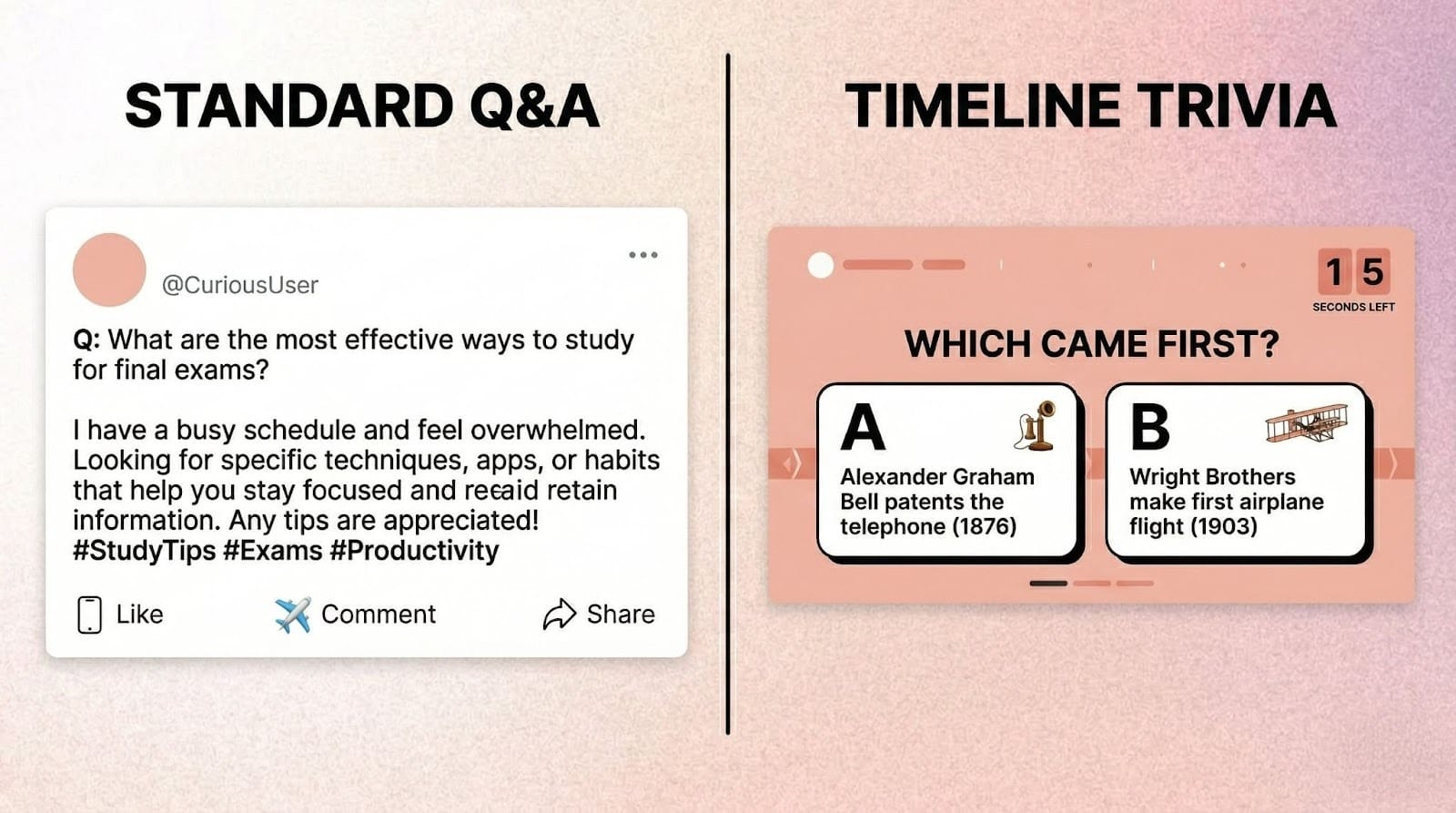
Caption: Standard Q&A vs. timeline trivia: the same question, a completely different level of engagement.
Alt-text: Split-screen comparison showing a plain standard Q&A post on the left and a visual timeline trivia card with two answer choices and a countdown timer on the right.
Why Timeline Trivia Drives Audience Retention
Three things make this format outperform standard Q&A for watch time and engagement:
1. Built-in suspense. Every timeline question has a reveal moment. Viewers stick around because they need to know if their guess was right. That anticipation loop is exactly what platforms like Instagram and TikTok reward with higher distribution.
2. Intuition over memorization. If someone does not know the exact year the iPhone launched, they still know it came after the iPod. Timeline trivia lets people play even when they are not sure, which keeps them engaged longer than a format that punishes wrong answers.
3. Shareability through surprise. When viewers discover that Oxford University is older than the Aztec Empire, they want to share that fact. Surprise drives comments and shares more reliably than difficulty alone.
Content patterns that work
- Old vs. new: “Which came first: the fax machine or the telephone?”
- Invention vs. invention: “Which came first: the lighter or the match?”
- Event vs. cultural milestone: “Which came first: MTV or the first CD player?”
- Put these in order: Three items from the same decade, ranked by release date.
Tactical Takeaway: Lead with your most counterintuitive fact. “Oxford University is older than the Aztec Empire” works as a hook because it breaks expectations immediately. Surprise drives comments and shares more reliably than difficulty alone.
How to Make a Timeline Trivia Quiz: Step-by-Step
Before you think about video, you need a strong quiz. Here is a simple process to build one from scratch.
Step 1: Pick a theme and narrow it down
Choose one topic area: 1990s tech, space exploration, pop music milestones, etc. A tight theme makes questions feel curated rather than random. Avoid mixing unrelated categories in a single round.
Step 2: Choose your question format
- “Which came first?” (two options): Easiest to create and play. Best for beginners and short-form video.
- “Put these in order” (three to four items): More challenging. Works well for longer videos and classroom settings.
- “Guess the year” (single event): Hardest format. Best for audiences who already enjoy trivia.
Step 3: Write your questions and fact-check everything
Trivia content demands very high accuracy. Double-check every date against a reliable source. Use specific years rather than vague ranges when possible, and note any edge cases (for example, whether a date refers to a Japan release vs. a US release).
Step 4: Sequence for difficulty and pacing
- Start with the easiest or most recognizable question, not the hardest.
- Build toward your most surprising reveal.
- Keep rounds short: three to five questions per video.
Step 5: Add context to your reveals
After each answer, include a one-line explanation of why the order is surprising. “The fax machine was patented in 1843, 33 years before Alexander Graham Bell’s telephone.” That extra line transforms a fact into a moment people want to share.
How to make timeline trivia video in under 60 seconds using Trivia by Typito AI
Quick creator playbook
- Use only two options for beginner-friendly “which came first” videos.
- Keep rounds short: three to five questions per video.
- Use events with a strong contrast in era for maximum surprise.
- Put the reveal on screen clearly, with years visible.
- Add a one-line explanation for why the order is surprising.
- For ranking rounds, use only three items, not five or six.
- Start with the easiest question to build viewer confidence.
How to Turn Timeline Trivia Into Interactive Video
The reveal moment in timeline trivia is always better experienced visually. Reading a date on a page does not carry the same weight as a progressive video reveal with a timer counting down.
What makes timeline trivia videos perform
- Countdown timers: Give viewers five to ten seconds to guess before the reveal. The pressure creates urgency.
- Progressive reveals: Show events one at a time rather than all at once. Each reveal builds suspense for the next.
- On-screen text with years: Make the answer unmistakable. Show the year prominently so viewers can instantly confirm or deny their guess.
- Comment prompts: End with “Comment your score” or “Did you get this one right?” to drive interaction.
Where to publish
This format performs exceptionally well on Instagram Reels, YouTube Shorts, and TikTok. The short, self-contained structure fits naturally into vertical video. It also works in classroom presentations, live event screens, and email newsletters with embedded video.
Tools and workflow
Many creators build these into countdown-style quiz videos to maintain pacing. Tools like Trivia by Typito Ai can generate countdown timers, animated sequences, and reveal cards automatically, letting you reuse the same format across different timelines. You can also use quiz video templates to skip manual editing and focus entirely on sourcing great questions.
➡ Ready to try it? Record one timeline trivia video this week using three questions from the list below. Publish it as a Reel with the caption “Comment your score below.” Even a simple three-question format is enough to test your audience and refine from there..
25 Timeline Trivia Ideas Organized by Theme
These questions are ready to use. Each category includes framing notes so you can pick the right set for your audience and platform.
Major World Events and Historical Firsts
Best for: broad audiences, educational content, YouTube Shorts. These questions work for almost anyone because the events are universally recognized. Start here if you are building your first timeline quiz.
- Which came first: the Wright Brothers’ first powered flight or the sinking of the Titanic? Answer: The Wright Brothers flew in 1903, nine years before the Titanic sank in 1912.
- Which came first: the first email or the moon landing? Answer: The moon landing (1969). The first email was sent by Ray Tomlinson in 1971.
- Which came first: the fall of the Berlin Wall or the invention of the World Wide Web? Answer: Both happened in 1989. Tim Berners-Lee proposed the Web the same year the Wall came down.
- Put these in order: first powered flight, Titanic sinking, moon landing. Answer: Wright Brothers (1903), Titanic (1912), Moon landing (1969).
- Which came first: the first photograph or the first railway? Answer: The first railway (Stockton and Darlington, 1825). The first surviving photograph dates to around 1826–1827.
For more history-themed inspiration, explore our guide on history trivia video ideas.
Pop Culture Milestones
Best for: social media audiences, nostalgia content, Instagram Reels. Pop culture questions tap into personal memory, which makes them feel more emotional and shareable than pure history.
- Which came first: the launch of MTV or the release of the first Star Wars movie? Answer: Star Wars premiered in 1977. MTV launched four years later in 1981.
- Which came first: the first iPhone or Netflix streaming? Answer: Both launched in 2007. The iPhone was unveiled in January; Netflix began streaming in February.
- Which came first: the first Harry Potter book or TikTok’s international launch? Answer: Harry Potter and the Philosopher’s Stone was published in 1997, twenty years before TikTok launched internationally in 2017.
- Put these in order by release: Star Wars, MTV, first iPhone. Answer: Star Wars (1977), MTV (1981), iPhone (2007).
- Which came first: the first YouTube video or the launch of Facebook? Answer: Facebook launched in February 2004. The first YouTube video was uploaded in April 2005.
Surprising Cross-Era Comparisons
Best for: viral content, TikTok, comment-driven posts. These are the questions that make people say “No way.” The answers consistently defy expectations, which is why this category drives the most shares.
- Which came first: the fax machine or the telephone? Answer: The fax machine. Alexander Bain patented a fax prototype in 1843, 33 years before Bell’s telephone in 1876.
- Which came first: Oreo cookies or chocolate chip cookies? Answer: Oreos debuted in 1912. Chocolate chip cookies were not invented until 1938.
- Which came first: Oxford University or the Aztec Empire? Answer: Oxford. Teaching at Oxford began around 1096. The Aztec Empire formed in the 1300s.
- Which came first: Betty White or sliced bread? Answer: Betty White. She was born in 1922. Pre-sliced bread was first sold in 1928.
- Which came first: the lighter or the match? Answer: The lighter. Döbereiner’s lamp appeared in 1823. The friction match followed in 1826.
- Which came first: the printing press or the telescope? Answer: The printing press. Gutenberg’s press dates to around 1440. The telescope was invented in 1608.
- Which came first: Harvard University or the discovery of calculus? Answer: Harvard was founded in 1636. Newton and Leibniz developed calculus in the late 1600s.
Decade-Based Ranking Rounds
Best for: longer quiz videos, classroom settings, gaming audiences. Ranking rounds are more challenging than two-choice questions, so they work best for audiences that already enjoy trivia. Keep each round to three items.
- Rank these 1990s console releases from earliest to latest: PlayStation, N64, SNES. Answer: SNES (1990 in Japan), PlayStation (1994), N64 (1996).
- Order these 2000s social networks by launch date: Facebook, Myspace, Twitter. Answer: Myspace (2003), Facebook (2004), Twitter (2006).
- Arrange these Marvel movies by release date: The Avengers, Iron Man, Thor. Answer: Iron Man (2008), Thor (2011), The Avengers (2012).
- Rank these 1980s pop hits by release year: Thriller, Take On Me, Like a Virgin. Answer: Thriller (1982), Like a Virgin (1984), Take On Me (1985).
- Order these Apple product reveals: iPad, Apple Watch, AirPods. Answer: iPad (2010), Apple Watch (2015), AirPods (2016).
[Image 3]
Prompt: Create a clean 16:9 horizontal flow diagram on a white or very light gray background. Show a five-step participation loop cycle connected by arrows flowing left to right: Step 1 "Post Timeline Quiz", Step 2 "Viewers Guess", Step 3 "Reveal the Answer", Step 4 "Comments and Shares", Step 5 "Replay and Reach". Use simple rounded rectangles for each step. Color palette: alternating deep blue and warm orange. A subtle arrow loops from Step 5 back to Step 1. Clean infographic style. No clipart or icons.
Caption: The timeline trivia participation loop: every reveal drives a new wave of comments, shares, and replays.
Alt-text: Horizontal flow diagram showing the five-step timeline trivia participation loop from posting the quiz through viewer guessing, answer reveal, comments and shares, to replay and reach.
For more tips on structuring rounds, explore our trivia format guides to see how experienced creators structure their quizzes.
Tactical Takeaway: Start with the “Surprising Cross-Era Comparisons” format if you are new to timeline trivia. It requires the least setup, works in any niche, and almost always generates comment debate. Pick two items from different eras, write the question, and post it today.
FAQs About Timeline Trivia
Q: What is the difference between timeline trivia and standard trivia?
Standard trivia asks for a single correct answer (“What year did X happen?”). Timeline trivia asks players to compare or sequence events, which means they can reason their way to an answer even without exact knowledge. This makes it more accessible and more engaging for casual audiences.
Q: How many questions should I include in a single timeline trivia video?
Three to five questions per video works best for short-form platforms. That length keeps the pacing tight and gives viewers enough rounds to feel like they played a real game without losing attention. For longer formats like YouTube or classroom quizzes, you can go up to eight to ten questions, grouped into themed rounds.
Q: Can I mix “which came first” and “put these in order” in the same video?
Yes, and mixing formats actually improves pacing. Start with two-choice questions to warm viewers up, then shift to a three-item ranking round as the difficulty peak. This structure mirrors how game shows build tension and keeps the experience from feeling repetitive.