At a glance: 3 riddle trivia formats that keep viewers watching until the end
Jump to a section:
- Why riddle trivia questions hold attention longer than standard quizzes
- 3 riddle trivia formats that solve viewer drop-off
- How to build riddle trivia videos without writing complex puzzles
- 20 riddle trivia examples organized by difficulty
- Common questions about riddle trivia formats
Standard trivia asks whether your audience knows the answer. Riddle trivia asks them to figure it out. That small difference changes the viewing experience entirely.
Instead of instantly recognizing a fact or scrolling past, viewers have to sit with the clue, test possibilities, and wait for the reveal. Riddles delay the answer on purpose. They force active processing. And when the reveal finally lands, it feels earned in a way that a direct question never quite does.
That makes riddle trivia one of the most naturally suspenseful formats for short-form quiz content. This guide walks you through how it works, with formats and examples you can adapt to your niche.
Why riddle trivia questions hold attention longer than standard quizzes
Standard trivia gives your viewer a direct question. They either know the answer or they do not.
Riddle trivia works differently. It wraps the answer in layers. The viewer has to decode the clue before they can even attempt a response.
That extra cognitive step creates a small but powerful tension. Viewers stay in the video longer because they are still working through the answer. Even after the reveal, many will re-watch just to confirm how the clue connected to the solution.
Tactical takeaway: Open your riddle trivia video with the puzzle itself, not an introduction. Every second before the riddle is a second viewers can scroll away.
Riddle trivia questions consistently generate guess-based comments, which signals high engagement to the algorithm. On YouTube Shorts, the replay loop drives up completion rates.
3 riddle trivia formats that solve viewer drop-off
The most effective riddle trivia formats do not require deep knowledge. They reward pattern recognition, wordplay, and fast thinking.
Here are three formats that work well for short-form riddle content.
1. The “What Am I?” riddle
Give viewers three clues in sequence, one at a time, each describing a single object or concept. Each clue should be slightly more obvious than the last.
This pacing rewards quick thinkers early and keeps slower guessers watching through all three clues. The buildup creates natural suspense that holds attention all the way to the reveal.
Best for: general audiences and first-time viewers
Strength: easy to understand and naturally suspenseful
Limitation: can feel too familiar if the object is obvious by clue two
Example: “I have hands but cannot clap. I have a face but no eyes. I tell you something every hour. What am I?” Answer: a clock. Simple, familiar, and easy to guess - which makes it a natural prompt for first-time viewers to drop their answer in the comments.
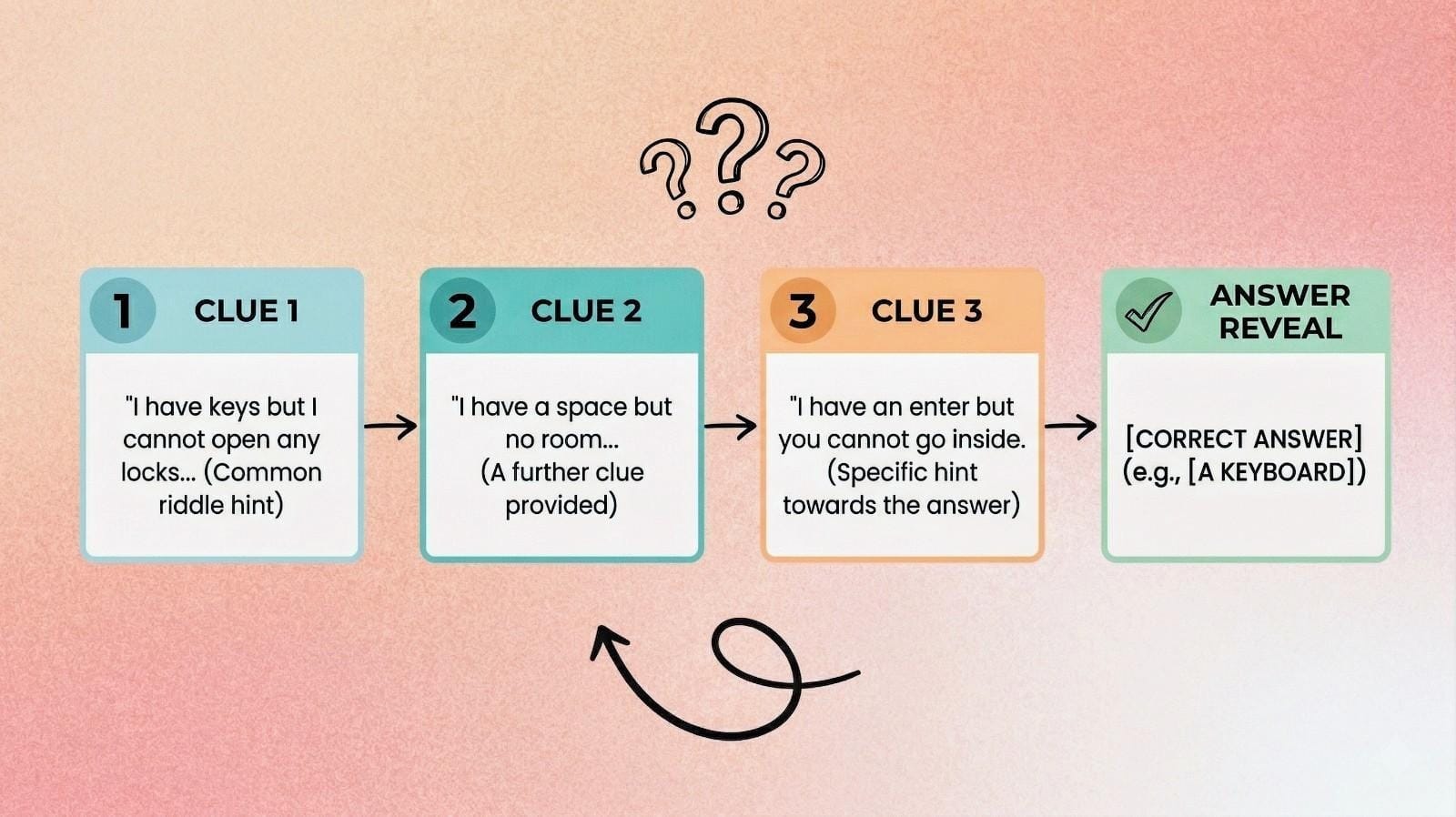
Caption: The 'What Am I?' format reveals clues one by one , each step adds clarity while keeping viewers watching all the way to the reveal.
Alt-text: Flow diagram showing three sequential clue boxes leading to an answer reveal box in the What Am I riddle trivia format
2. The “Wordplay Twist” format
Present a sentence or short phrase that sounds like one thing but means something else entirely. Give viewers 5 seconds to guess before revealing the double meaning.
Example: “Forward I am heavy. Backward I am not. What am I?” Answer: the word ton. Reversed, it spells not. This format works well for brand trivia, movie title riddles, and idiom challenges.
Viewers frequently arrive at different answers with this format, which tends to spark back-and-forth discussion in the comments.
Best for: puzzle audiences, language play, short stand-alone posts
Strength: surprising reveal that rewards careful reading
Limitation: too much wordplay can frustrate casual audiences
3. The “Fill the Blank” riddle chain
Give the first half of a well-known riddle and let the comment section finish it. Post the answer as a reply or in a follow-up video.
Example: “The more you take of me, the more you leave behind. What am I?” Drop only the first line and let comments guess. The answer is footsteps, but you never tell them upfront.
This format works best when your audience is already familiar with riddle structures. It extends engagement across two touchpoints - the initial post collects guesses, and the follow-up reveals the answer and invites reaction. It works less well if viewers are unfamiliar with the riddle form, since the prompt can feel incomplete rather than suspenseful.
Best for: comments and follow-up posts
Strength: easy to extend into a second touchpoint and keeps the conversation open
Limitation: weaker if your audience does not already know the riddle form
If you enjoy riddle-based puzzle trivia formats, check out our full guide on how to make a trivia game to see how these fit into a broader content strategy. You might also like our guides on fill-in-the-blank trivia quizzes and niche trivia challenges for Reels and Shorts.
How to build riddle trivia videos without writing complex puzzles
You do not need to invent original riddles from scratch. The examples in the next section give you a ready-made starting point. Pick one, adapt it to your niche, and build your video around a clear, repeatable structure.
Lead with the riddle itself whenever possible. Every second before the puzzle is a second a viewer can scroll away. Once the riddle is on screen, give them space to sit with it before revealing the answer. Here is how to structure that, depending on your format.
One-riddle short video (Reels / Shorts)
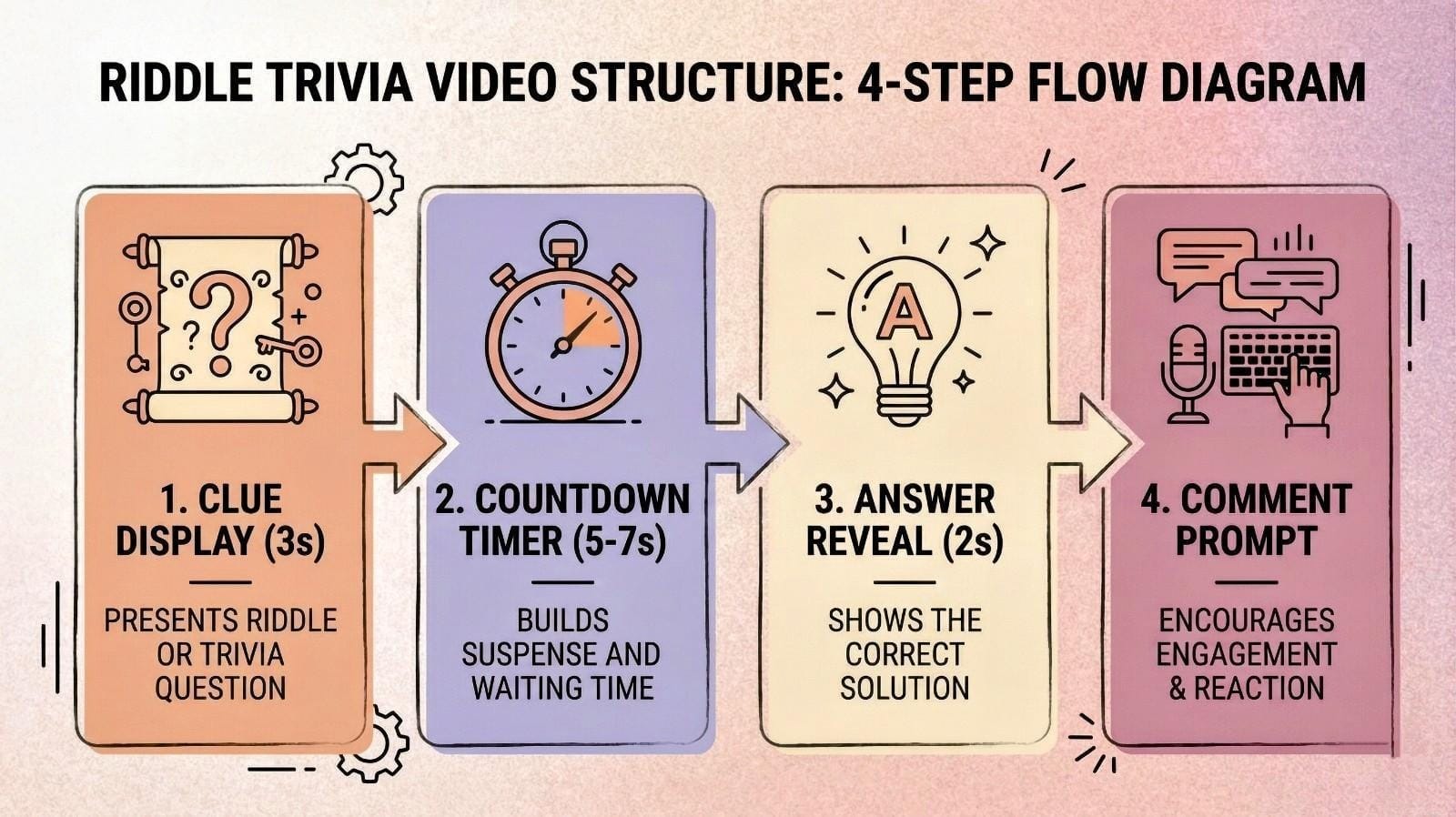
Show the clue for 3 seconds. Run a countdown for 5 to 7 seconds - long enough to feel suspenseful, short enough not to drag. Reveal the answer. Include a brief explanation only when the clue logic is not obvious; if the answer lands cleanly on its own, let it. End with a comment CTA (“Did you get it? Drop your answer below”). For wordplay riddles, silence during the thinking window works better than music - it forces focus onto the words.
Multi-riddle round (3 to 5 riddles)
Keep Shorts and Reels to 3 to 5 riddles maximum - more than that and the format starts to feel like a test rather than a puzzle. Sequence clues so each one is slightly harder than the last. Use a light tension audio track during the thinking window, and switch to a neutral tone for the reveal. How long a clue stays on screen depends on its complexity: a single-line riddle can hold for 3 to 4 seconds; a three-clue sequence may need 5 to 7 seconds per clue.
Long-form compilation (YouTube)
Group riddles by difficulty or theme rather than mixing randomly. Segment labels (“Easy round,” “Medium round,” “Hard round”) set expectations and help viewers stay oriented. Use a voiceover for the reveal only when the explanation genuinely adds to the moment - for abstract answers like “a question” or “a promise,” a short spoken note works better than silence. For more visual riddles like “a shadow” or “fire,” the answer can carry itself. For a step-by-step guide to building a full trivia video, see our guide on how to make a trivia game.
Many creators turn riddle trivia questions into short videos with animated timers, text reveals, and voiceovers. Tools like Trivia by Typito let you build these elements quickly without opening a video editor.
Tactical takeaway: Lead with the riddle itself whenever possible. Test easy, medium, and hard prompts with your audience and see which difficulty they actually respond to - the answer is rarely what you expect from the outside. Once you have a sense of what resonates, batch-create around that tier and use the others to shift gears when engagement plateaus.
20 riddle trivia examples organized by difficulty
Use this as your ready-to-post swipe file. Each riddle includes the answer and a creator tip so you know exactly how to frame it for maximum engagement. Start with Easy if you are testing a new audience. Jump to Hard when your community is ready for a real challenge.
Easy (Riddles 1 to 7)
These riddles are short, familiar, and instantly rewarding. Easy riddles are ideal for warming up a new audience, growing your comment section fast, and training viewers to engage. Because the answer feels satisfying rather than frustrating, easy riddles generate the highest volume of replies. Use them for your first riddle trivia post or whenever you want to reset engagement after a quiet period.
Riddle 1: “I grow shorter the longer I stand. I need air to live, but air is also what kills me. I give light and warmth, but I fade as I give. What am I?”
Answer: A candle
Best for: quiet reveal videos, lifestyle and mindfulness niches
Creator tip: Pairs naturally with slow, warm b-roll - a flame in a dark room, a candle burning down. The three-clue structure suits the “What Am I?” format well. Good for lifestyle, mindfulness, or ambient content niches where the visual does most of the storytelling.
Riddle 2: “I have hands but cannot clap. I have a face but no eyes. I tell you something every hour. What am I?”
Answer: A clock
Best for: first-time audiences; easy to guess and satisfying to reveal
Creator tip: This three-clue structure is a perfect template for the “What Am I?” format. Record each clue appearing one at a time on screen with a 2-second pause between them.
Riddle 3: “I always follow you but I am never beside you. I shrink in bright light and disappear in the dark. I have your shape but none of your thoughts. What am I?”
Answer: A shadow
Best for: personal development, philosophy, and reflective content niches
Creator tip: Works well for personal development, philosophy, and reflective content niches. Post only the riddle and ask viewers to guess in the comments. After 24 hours, reveal the answer in a pinned reply and follow it with a short reflection: “What does your shadow say about you?” The metaphor gives the reveal a second layer that keeps the thread open.
Riddle 4: “I am always in front of you but can never be seen. What am I?”
Answer: The future
Best for: emotionally resonant niches; motivational and lifestyle content
Creator tip: Use this for motivational or lifestyle content niches. The answer resonates emotionally, which means viewers are more likely to share it with someone rather than just commenting alone.
Riddle 5: “I speak every language but have never taken a lesson. I can make you laugh, cry, or remember something you forgot. I am invisible but I fill every room. What am I?”
Answer: Music
Best for: music creators and any emotion-driven content
Creator tip: Works across nearly any niche because the answer is universally felt. Music, lifestyle, and emotion-driven content creators will find this especially strong for pause-and-process formats. The answer lands on a feeling rather than a fact, which gives it a satisfying reveal that is hard to argue with.
Riddle 6: “I speak without a mouth and hear without ears. I repeat your words but have no body. What am I?”
Answer: An echo
Best for: nature, travel, and outdoor content niches
Creator tip: Pair this riddle with outdoor b-roll of a canyon or empty stadium. The visual context adds a layer of atmosphere without giving away the answer. Viewers who guess right feel clever.
Riddle 7: “I have cities but no houses, mountains but no trees, and water but no fish. What am I?”
Answer: A map
Best for: general audiences and first-time viewers
Creator tip: This is a classic misdirection riddle. The answer always gets a wave of “oh wow” comments, which are some of the best signals for algorithmic reach. Add a slow zoom-in on an actual map in your reveal.
Medium (Riddles 8 to 14)
These riddles require a genuine pause. Viewers cannot answer on instinct alone; they need to think it through. Medium difficulty is the sweet spot for most established audiences because it creates just enough friction to feel earned. Expect longer comment threads, more back-and-forth debate, and higher replay rates compared to easy riddles.
Riddle 8: “I have a head and a tail but no body. I am never alive but I am always in demand. What am I?”
Answer: A coin
Best for: comment debates and interactive poll formats
Creator tip: Run this as a “heads or tails” style poll before revealing the full riddle. Ask viewers to pick a side in comments first, then post the actual question. The two-step engagement doubles your comment volume.
Riddle 9: “I am light as a feather, but even the strongest person cannot hold me for more than a few minutes. What am I?”
Answer: Their breath
Best for: fitness, wellness, and health content niches
Creator tip: This riddle plays against physical expectations, which makes it great for fitness and wellness creators. The contrast between “light as a feather” and the impossibility of holding it creates genuine curiosity before the reveal.
Riddle 10: “The person who makes me does not need me. The person who buys me does not use me. The person who uses me does not know it. What am I?”
Answer: A coffin
Best for: quiet, minimal-aesthetic reveal videos; high-impact moments
Creator tip: This is a high-impact riddle that works best posted with a slow, minimal visual and no music. Let the words do the work. The answer creates a strong emotional beat that viewers remember and reshare. Use it sparingly for maximum effect.
Riddle 11: “I am born in silence but I grow with noise. I can be small enough to fit in your ear or big enough to fill a stadium. I am never seen but always felt. What am I?”
Answer: Sound
Best for: music, audio, and tech content creators
Creator tip: Works well for music, audio, and tech creators. The three clues each approach sound from a different angle - scale, origin, and perception - which makes the reveal more satisfying to sit with. Pair with a waveform animation or a simple sound-wave visual for a stronger pause before the answer.
Riddle 12: “You can see me in water but I never get wet. What am I?”
Answer: A reflection
Best for: nature, travel, and quiet reveal video formats
Creator tip: Short, elegant, and easy to visualize. Film this as a reveal video showing a still lake, then slowly reveal the answer as the camera pans down to the reflection. The visual storytelling does most of the work for you.
Riddle 13: “I am not alive but I can grow. I have no lungs but I need air. Water kills me. What am I?”
Answer: Fire
Best for: science, education, and curiosity-driven niches
Creator tip: Three-clue “What Am I?” format at its best. Each clue contradicts common assumptions, which builds frustration in the best possible way. The answer creates immediate relief. Post a satisfying fire extinguisher reveal clip to end the video.
Riddle 14: “The more you share me, the less of me remains. What am I?”
Answer: A secret
Best for: storytelling, personal development, and relationship niches
Creator tip: This riddle lands exceptionally well in storytelling, marketing, and personal development niches. Ask viewers in the comments: “What is a secret you wish you had kept?” The riddle becomes a conversation starter, not just a quiz question.
Hard (Riddles 15 to 20)
These riddles are designed to divide your audience. Some viewers will crack them immediately and feel like geniuses. Most will have no idea and will wait for the reveal with genuine anticipation. Hard riddles are best used once your audience trusts your content style and is hungry for a challenge. They drive the highest share rates because viewers want to test their friends.
Riddle 15: “What comes once in a minute, twice in a moment, but never in a thousand years?”
Answer: The letter M
Best for: wordplay and puzzle audiences
Creator tip: This is a pure wordplay riddle that completely bypasses knowledge or logic. It only clicks once you stop thinking about time and start thinking about letters. Because the answer is so unexpected, the reveal gets a strong emotional reaction. Viewers tag friends who love puzzles.
Riddle 16: “Forward I am heavy. Backward I am not. What am I?”
Answer: The word “ton” (reversed it spells “not”)
Best for: wordplay and puzzle audiences
Creator tip: Keep the screen completely blank except for the riddle text and a countdown. No music, no animation. The silence makes viewers focus entirely on the words. When the answer appears, the wordplay hits harder because nothing distracted from it.
Riddle 17: “What can you hold in your right hand but never in your left hand?”
Answer: Your left hand
Best for: comment debates; viewers who enjoy lateral thinking puzzles
Creator tip: This riddle generates the most “wait, what?” comments of any on this list. The answer is so simple and so obvious once you see it that viewers immediately want to share it. Add a pause of 3 full seconds after the reveal before any text appears. Let the silence sell the punchline.
Riddle 18: “I can enter a room without opening a door. I can travel any distance without moving. I have no hands, but I can move you. What am I?”
Answer: A voice
Best for: podcasters, commentary creators, and brand-voice content
Creator tip: Strong for podcasters, commentary creators, and anyone whose brand depends on how they communicate. The answer is both literal (a physical voice) and metaphorical (your content voice), which gives you a natural hook into a second-layer conversation. Ask viewers: “What one word describes your voice?” and let the comments do the work.
Riddle 19: “The more I am answered, the more I multiply. I have no colour but I change how you see the world. I am older than language but always new. What am I?”
Answer: A question
Best for: educational, philosophy, and coaching niches
Creator tip: Works well for educational, philosophy, and coaching content. The answer is abstract but immediately recognizable once it lands. After the reveal, ask viewers: “What question are you sitting with right now?” - the riddle becomes an opener for a deeper conversation in the comments rather than a closed trivia moment.
Riddle 20: “I am not born but I can die. I have no heart but I can be broken. I am not real but I can change your life. What am I?”
Answer: A promise
Best for: emotionally resonant niches; milestone or closing posts
Creator tip: Save this for a milestone post such as hitting a follower count goal or wrapping up a content series. The emotional weight of the answer gives you room to connect the riddle to your own story or brand message. This is the one riddle on this list that works as both a quiz and a closing statement.
Once you have worked through these examples, layer in visual elements to increase replay value. Our guide to emoji-based quizzes shows how to combine striking visuals with puzzle-style questions for even higher engagement.
Common questions about riddle trivia formats
Q1: How do I test whether a riddle is too easy or too hard before posting?
Answer: Send the riddle to three to five people outside your niche and note how quickly they respond. If everyone answers immediately without pausing, the riddle may feel too familiar and is unlikely to hold attention long enough. If nobody gets close after a good while, it may be too obscure and risk frustrating viewers before the reveal. The goal is a riddle that creates a genuine pause - not an instant answer, not an impossible one. You can also post it as a text-only Story with a question sticker and check whether your audience actually engages before committing to a full video production.
Q2: How many riddles should I include in one video?
Answer: For short-form content on Reels or Shorts, one strong riddle per video works best. If you are creating longer YouTube content, a themed set of 5 to 10 riddle trivia questions grouped by difficulty keeps viewers watching without losing momentum. Try grouping all seven easy examples into a single “warm-up round” video and see how it performs against a single hard riddle post.
How do I sequence riddle trivia across a weekly content calendar?
One useful starting pattern is to follow a difficulty curve across the week - an easy riddle early in the week to warm up your audience, a medium riddle mid-week to sustain interest, and a harder riddle toward the weekend when viewers tend to have more time to sit with a challenge. That said, this is a starting experiment, not a fixed rule. Some audiences respond better to a consistent difficulty tier than a rotating one. If you batch-create content, record several riddles in one session and test whether your audience responds more to difficulty, variety or consistency - then build your rhythm from what you observe.
Can I combine riddle trivia with other trivia formats in the same video?
Mixing formats works well when each format serves a different role in the video. Start with a quick fill-in-the-blank round to warm up the audience, then transition into a “What Am I?” riddle as the main event. The format shift keeps viewers alert because they cannot settle into a single answering pattern. For longer YouTube content, try alternating between three easy multiple-choice questions and one hard riddle every few minutes. The easy questions build confidence, and the riddle resets the tension. Keep the transition clean by using a brief visual cue like a colour change or a sound effect so viewers know the format is shifting.