Most trivia formats test what you know. Quote trivia tests something harder: ,whether you can recognize a voice, a style, or a way of thinking.
That shift changes how people engage with it. When someone reads a quote, they're not searching their memory for a fact. They're reading the tone, the rhythm, the personality behind the words, and making a judgment call. That guess feels personal in a way that "what year did this happen" never quite does.
Which is why the reveal lands differently, too. Getting it right feels like you actually know the person. Getting it wrong, especially when you were confident, creates the kind of surprise that makes people want to share it or argue about it in the comments. Both reactions are good for the format.
The "Guess Who Said It" structure works because it sits at the intersection of knowledge and instinct. People aren't just recalling information; they're trusting their read of someone, and that investment is what makes the format stick.
At A Glance
- Why "Guess Who Said It" Works So Well
- What Makes a Good "Guess Who Said It" Question
- How to Build Your Quote Trivia Quiz
- 20+ Guess Who Said It Trivia Ideas (Ready to Use)
- Which Platform Should You Post It On?
- Common Mistakes That Kill Engagement
Why "Guess Who Said It" Works So Well
Most trivia tests knowledge. Quote trivia tests identity.
When the guess feels right, it confirms something about how well they read people. When it's wrong, it usually means the quote surprised them in a specific way: the tone was off, the context was unexpected, or they'd been confidently misattributing it for years. That specificity is what tends to generate comments rather than just passive views.
Why the format works:
- It invites debate because multiple speakers find it plausible. A sharp one-liner could belong to several people. Two viewers can land on completely different guesses, and both have a reasonable case, which is exactly the kind of disagreement that plays out in comment sections.
- The reveal is stronger when it adds context. Not just who said it, but when, and why. That extra layer gives viewers something to carry away, which is why quote trivia tends to get saved more than formats where the answer is purely factual.
- Misattributions work because people bring prior assumptions. When a quote someone has been sharing for years turns out to have a different source, the surprise isn't just interesting, it's personal. That tends to prompt sharing more than a straightforward correct answer would.
- Wrong answers aren't a failure of the format. When the speaker is genuinely surprising, getting it wrong feels like a discovery rather than an error. The humility of being confidently wrong is a different kind of engagement, but it's still engagement.
Where this format works best
- Motivational & business quotes. Misattributed ones are gold; audiences love discovering that a quote they've been sharing for years wasn't actually said by who they thought.
- Movie & TV dialogue. Lines people know by heart but can't quite place, especially from ensemble casts where multiple characters could plausibly have said it.
- Historical figures. Quotes from leaders, scientists, and authors where the style gives clues but doesn't give it away.
- Sports. Locker room quotes, post-game interviews, and famous trash talk are highly shareable in sports communities.
- Classroom & team events. Literature quotes, famous speeches, and discipline-specific thinkers make excellent warm-up rounds.
What Makes a Good "Guess Who Said It" Question
The quote does all the work. If it's too famous, there's no tension. If it's too obscure, there's no engagement. The sweet spot is a quote that feels familiar enough to guess but surprising enough to doubt.
Strongest quote types:
- Wise but generic in tone: sounds like it could belong to several people across different eras
- Blunt or contrarian: unexpected phrasing that doesn't match the speaker's public image
- Era-neutral: no obvious cultural or linguistic markers that give the period away
- Surprising in context: the quote makes more sense once you know who said it and why
Weak quote types:
- Over-famous: "I have a dream" has one answer. No debate, no tension
- Too tied to one person: if the voice is instantly recognisable, the format collapses
- Too context-heavy: requires background knowledge that most of your audience won't share
- Too short to infer tone: single sentences with no personality don't give people enough to work with
When misattributions are especially useful: When your audience already has a strong assumption about who said something. The gap between what they expect and what's true is where the engagement lives.
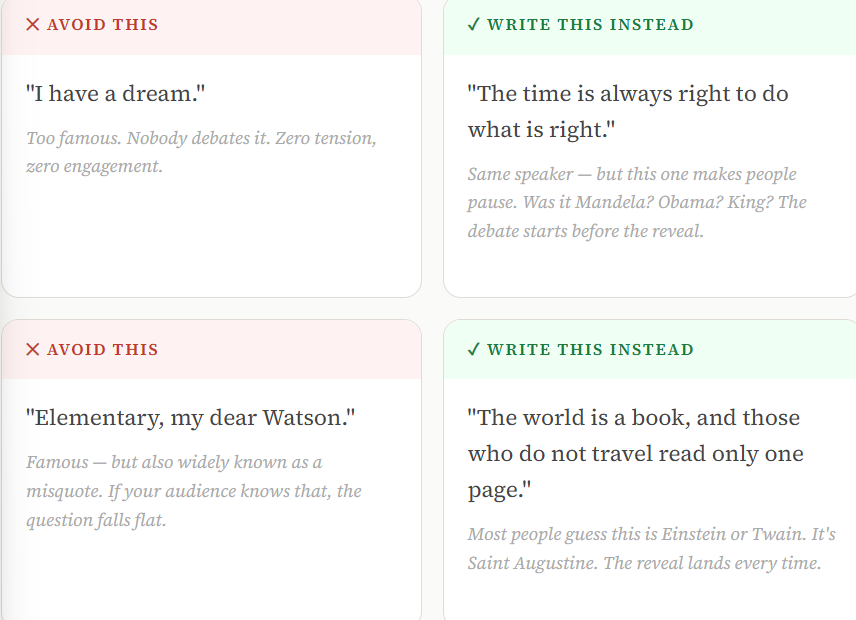
The 3 rules for picking the right quote
Rule 1: The quote should sound like it could have multiple authors
The best quotes sound universal, wise, funny, or blunt in a way that multiple famous people share. That ambiguity is what creates the debate.
- Strong: philosophical, punchy, or counterintuitive, sounds like it could be from several well-known thinkers.
- Weak: too specific to one person's life, era, or public persona, the speaker is obvious from context alone.
Rule 2: The speaker should be someone the audience recognises
Quote trivia is only satisfying when the answer is someone the audience has heard of. An unknown speaker makes the reveal feel flat, even if the quote is great.
- ✓ Historical icons, athletes, actors, musicians, scientists, business leaders, anyone with name recognition in your niche.
- ✕ Obscure academics, minor historical figures, or niche experts your audience has never encountered.
Rule 3: Add a clue, but not the answer
A hint about the era, field, or context narrows the playing field without giving it away. It keeps casual players in the game without making it trivial for the knowledgeable ones.
- Good clue: "Said by a 20th-century scientist" narrows the pool without pointing to one person.
- Too much: "Said by a physicist who developed the theory of relativity" That's just the answer.
When this format is a bad fit: skip it if the quotes in your niche are too niche (only superfans would recognise the speaker), too culturally specific for a global audience, or if the quote is so short it gives nothing for the audience to work with.
One-word or fragment quotes rarely create enough engagement to be worth it.
How to Build Your Quote Trivia Quiz
1. Pick a speaker category your audience already follows
Broad quote pools get ignored. Tight speaker categories get played. The more specific the group, tech founders, 90s athletes, sitcom characters, the more your audience thinks "this was made for me" and sticks around to guess every single one.
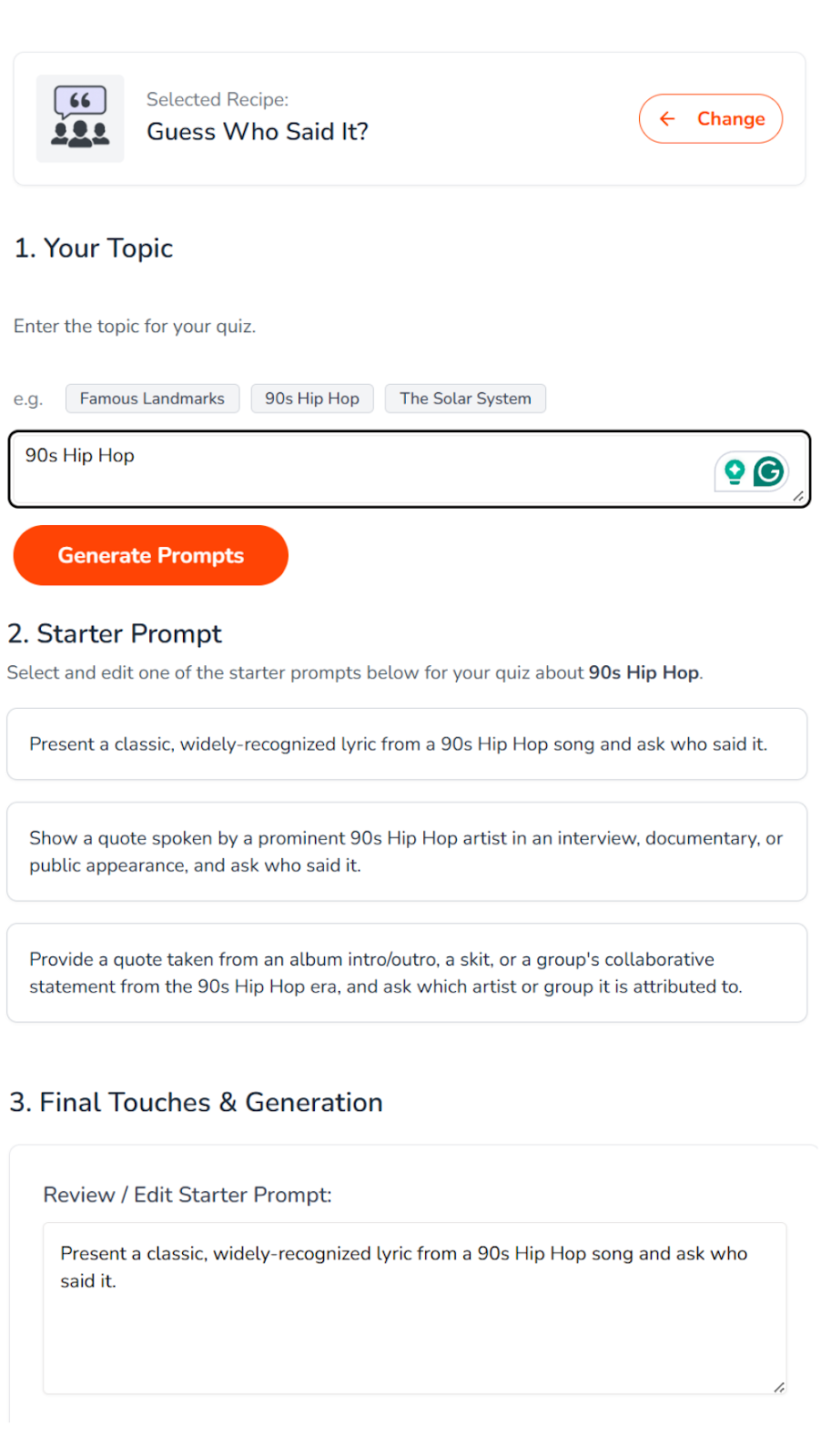
2. Pick your starting point with Trivia by Typito AI
Trivia by Typito AI gives you two ways to start. Both are fast; one gives you more control, the other gets you to a finished video even faster.
Option A: Custom prompt (you write the brief)
Click the custom template tile and write a specific prompt. Include: speaker category, quote tone, number of questions, difficulty mix, and platform aesthetic.
"Generate a 'Guess Who Said It?' trivia quiz with 8 motivational quotes from iconic tech founders and startup leaders. 5 easy, 3 hard. Use a clean, dark theme suited for LinkedIn and Instagram Reels."
Option B: Pick a recipe (Typito AI writes the prompt)
Browse ready-made quiz templates → select "Guess Who Said It?" → describe your speaker category → Typito AI builds the full prompt → review, edit if needed, hit generate.
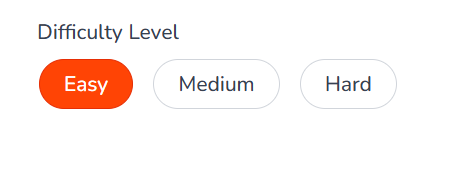
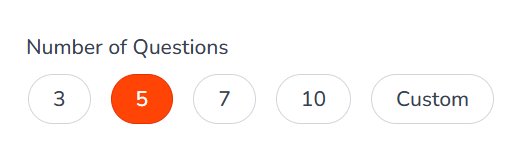
3. Aim for 6–10 quotes per round and build a difficulty arc
6-10 quotes is the sweet spot: enough to feel like a complete round, short enough to replay and share in one sitting
4. Decide your format: social post, live event, or video
The same quotes work as a comment-bait Instagram caption, a live trivia-style round, or a short video with a speaker reveal. The format changes the experience; the quotes are the foundation.
What changes by format
- For comments (social post). Lead with the quote and blank the speaker's name, end with "Who said this? Drop it below 👇". Make guessing feel low-stakes, casual followers attempt it, save your hardest misattributed quotes for your most dedicated trivia followers.
- For Stories. Use the built-in quiz sticker with four multiple-choice speaker options. Follow up in DMs with the correct answer and one line of context for everyone who replied, great for deepening the connection with your most engaged audience.
- For video (Reels/Shorts/TikTok). Show the quote for 4 seconds, run a visible countdown for 7–10 seconds, then cut to the reveal with the speaker's name and one line of context. That context line is what makes people save it, don't skip it.
Guess the iconic song Lyrics by Typito AI
20+ Guess Who Said It Trivia Ideas (Ready to Use)
Grouped by category with audience tags so you can pick the right set for your platform, event, or classroom round.
1. Motivational & Business Quotes
Best for: LinkedIn, professional teams, brand content, B2B audiences
Best format: text post or talking-head video
Q1. “Conformity is the jailer of freedom and the enemy of growth.” Answer: John F. Kennedy, 35th U.S. president
🏷️ Best Instagram
Q2. "Innovation distinguishes between a leader and a follower."
Answer: Steve Jobs
🏷️ Best for LinkedIn | Best for professional teams
Q3.The only way you are going to have success is to have lots of failures first.”
Answer: Sergey Brin, co-founder, Google
🏷️ Best Instagram
Q4. "It always seems impossible until it's done."
Answer: Nelson Mandela
🏷️ Best for LinkedIn | Best for classroom use
Q5. "A leader is best when people barely know he exists."
Answer: Lao Tzu
🏷️ Best for classroom use | Harder difficulty
Q6. "Whether you like it or not, history is on our side. We will bury you."
Answer: Nikita Khrushchev — often misread as a military threat; he meant economic competition.
🏷️ Best for classroom use | Best reveal with context
2. Pop Culture: Movies & TV
Best for: Instagram Reels, TikTok, broad social audiences, entertainment accounts
Best format: short-form video with on-screen countdown
Q1. "Get busy living, or get busy dying."
Answer: Red, The Shawshank Redemption
🏷️ Best for Reels | Good debate starter
Q2. "Roads? Where we're going, we don't need roads."
Answer: Doc Brown, Back to the Future
🏷️ Best for Reels
Q3. "You can't handle the truth!"
Answer: Col. Nathan Jessup (Jack Nicholson)
🏷️ Best for Reels
Q4. "I am serious. And don't call me Shirley."
Answer: Dr. Rumack (Leslie Nielsen), Aeroplane: !
🏷️ Best for broad social | Good generational split
Q5. "Life is like a box of chocolates."
Answer: Forrest Gump
🏷️ Best for Reels
3. Historical Figures
Best for: educational accounts, classroom warm-ups, LinkedIn, history communities
Best format: slower paced, longer countdown window
Q1."The world is a book, and those who do not travel read only one page."
Answer: Saint Augustine
🏷️ Best for classroom use | Harder difficulty
Q2."Imagination is more important than knowledge."
Answer: Albert Einstein
🏷️ Best for classroom use
Q3. "Give me a lever long enough, and I shall move the world."
Answer: Archimedes
🏷️ Best for classroom use
Q4. "Give me liberty, or give me death."
Answer: Patrick Henry
🏷️ Best for classroom use | Good debate starter
Q5. "Not all those who wander are lost."
Answer: J.R.R. Tolkien
🏷️ Best for classroom use | Good debate starter
4. Sports
Best for: sports accounts, fan communities, team event icebreakers, Reels
Best format: short-form video or live event round
Q1."I've missed more than 9,000 shots in my career. I've failed over and over again. That is why I succeed."
Answer: Michael Jordan
🏷️ Best for Reels | Best for team events
Q2. "It's just a job. Grass grows, birds fly, waves pound the sand. I beat people up."
Answer: Muhammad Ali
🏷️ Best for Reels | Good reveal with context
Q3."Champions keep playing until they get it right."
Answer: Billie Jean King
🏷️ Best for team events | Best for LinkedIn
Q4. You play to win the game."
Answer: Herm Edwards, then-coach of the New York Jets, in a 2002 press conference, often quoted without knowing the source.
🏷️ Best for sports communities | Good debate starter
Q5. Talent wins games, but teamwork and intelligence win championships."
Answer: Michael Jordan
🏷️ Best for team events
5. Famous Misattributions
Best for: highest engagement, people argue loudly when they get these wrong
Best format: any — the reveal does the work
Q1. "If you can dream it, you can do it."
Answer: Written by Imagineer Tom Fitzgerald
🏷️ Best for team events
Q2."Not all those who wander are lost."
Answer: J.R.R. Tolkien
🏷️ Best for LinkedIn
Q3. "The only thing we have to fear is fear itself."
Answer: Franklin D. Roosevelt
🏷️ Best misattribution round | Best for Reels | High engagement
Q4."First,It they ignore you. Then they laugh at you. Then they attack you. Then you win"
Answer: advocate Nicholas Klein in 1918
🏷️ Best misattribution round | Best for LinkedIn | High engagement
Q5. "I disapprove of what you say, but I will defend to the death your right to say it"
Answer: It was actually written by Evelyn Beatrice Hall
🏷️ Best for classroom use
Need more questions? Build a full quiz in minutes or export Questions in CSV Format with Trivia by Typito AI.
Start your journey with Typito AI
Which Platform Should You Post It On?
Quote trivia adapts well to every platform, but the format that works on LinkedIn looks nothing like what works on TikTok. Here's what shifts.
Common Mistakes That Kill Engagement
❌ Using quotes that are too famous. "Be the change you wish to see in the world" is instantly recognisable. Nobody debates it, nobody comments. Find the lesser-known quotes from well-known people, the ones that sound like they could belong to two or three different speakers.
❌ No hint at all. Without any context clues, casual audiences disengage immediately. A single hint era, field, nationality, or tone keeps more people in the game without giving the answer away.
❌ Skipping the context on the reveal. Showing just the speaker's name misses the best engagement moment. Add one line about why they said it or when. That's what makes people save it or send it to someone.
❌ No call to action. "Who do you think said this?" is a four-word line that prompts comments. Without it, even engaged viewers scroll past without typing anything.
❌ Quotes that are too short to infer anything. A five-word quote gives the audience nothing to work with, no style, no vocabulary, no perspective. The guessing process relies on reading tone and personality. Short quotes collapse that. Aim for at least two sentences, or one punchy line with enough character to feel like someone.
❌ Choosing speakers the audience doesn't know. The format only works when viewers have an opinion. If the speaker is obscure enough that nobody has a prior sense of how they talk or what they believe, there's nothing to guess from just a blank. Stick to speakers your specific audience is likely to have encountered, even loosely.
❌ Pulling quotes from unverified graphic posts. Half the quote graphics circulating online are wrong, misworded, misattributed, or invented entirely. Always trace a quote back to a primary source or a verified fact-checking site before publishing. Getting called out in the comments for a bad source does more damage than a low-performing post.
Ready to Make Your First Quiz Video?
A trivia video tool can help speed up the production side once you know the format you want to test.
FAQs
Q1. What types of quotes work best for social media trivia?
Answer: Quotes that sound like they could have come from multiple famous people work best, especially motivational quotes, movie lines, and historical sayings that are widely shared but whose true origins are often surprising. Misattributed quotes are particularly effective because the reveal creates a "wait, really?" moment that drives shares.
Q2.How many quotes should go in one trivia video or Reel?
Answer: For a single Reel or Short, one quote works best, quote on screen, countdown, reveal, under 15 seconds. For a full trivia round (live event, classroom, or carousel), 5–8 quotes is the sweet spot.
Q3. How does Quote Trivia boost social media engagement?
Answer: It creates debate. Two people watching the same post can have genuinely different guesses, and both feel compelled to comment on their answer. Comments with competing answers also signal high engagement to platform algorithms.
Q4.What topics work best for casual audiences unfamiliar with trivia formats?
Answer: Movie and TV quotes, sports figures, and widely shared motivational quotes are the most accessible starting points. The key is choosing speakers your audience already has a loose connection with.