You post the quiz. A few people like it. Nobody fills it in.
Multiple-choice makes guessing easy. True or false makes deciding fast. Fill-in-the-blank does something harder and more interesting.
It makes the audience retrieve the answer for themselves. There's no list to scan, no option to recognise. Just a blank, a pause, and a moment of genuine thinking.
That pause is what changes everything. Instead of tapping an option, the reader has to think, type, and commit. The format works best when the answer feels just out of reach; that "I know this… wait…" moment is exactly where engagement begins.
This guide walks through how to write questions that land, formats that work across platforms, and 15 ready-to-use examples you can remix today.
AT A GLANCE
- Why Fill-in-the-Blank Trivia Actually Works
- What Makes a Fill-in-the-Blank Question Actually Work
- 15 Fill-in-the-Blank Trivia Questions (Ready to Use)
- How to Build Your Fill-in-the-Blank Quiz: A Step-by-Step Workflow with Typito AI
- How to Avoid Common Mistakes with Fill-in-the-Blank Trivia
Why Fill-in-the-Blank Trivia Actually Works
When someone sees a multiple-choice question, recognition does the heavy lifting. They scan the options, and something clicks. Fill-in-the-blank offers nothing to recognise, the brain has to find the answer on its own.
"That moment of effort, even when someone gets it wrong, creates a stronger memory than passive reading ever could."
A 2024 analysis on active recall in digital learning environments found that retrieval-based formats consistently outperform recognition-based ones for both engagement and retention. The format works because it interrupts the scroll, and that interruption is the point.
- Forces a micro-decision: "Do I know this?"
- The answer reveals triggers a dopamine loop — guessing, then finding out
- Comments fill up naturally as people post their answers, signalling engagement to platform algorithms
- Works on social posts, live events, newsletters, and video formats equally well
Where this format works best
Not every topic is a good fit. Fill-in-the-blank performs best when the subject is familiar enough to feel guessable, but specific enough to create real tension. These categories consistently land:
- Nostalgia content. Childhood brands, 90s TV show theme songs, discontinued products- the "I used to know this" feeling is pure gold.
- Recognisable pop culture. Records, firsts, and surprising facts about shows, films, and artists people already know well.
- Brand and product memory. Original taglines, founding years, old logos, great for communities built around a niche or industry.
- Sports records. Numbers and milestones that sound too extreme to be real, "the first team to…", "the year X happened…"
- Geography surprises. Facts people half-remember from school but can't quite pin down.
What Makes a Fill-in-the-Blank Question Actually Work
The sweet spot is a question where the reader thinks "I should know this", not "that's impossible" and not "too easy, why bother."
Here's the pattern shift that makes the difference:
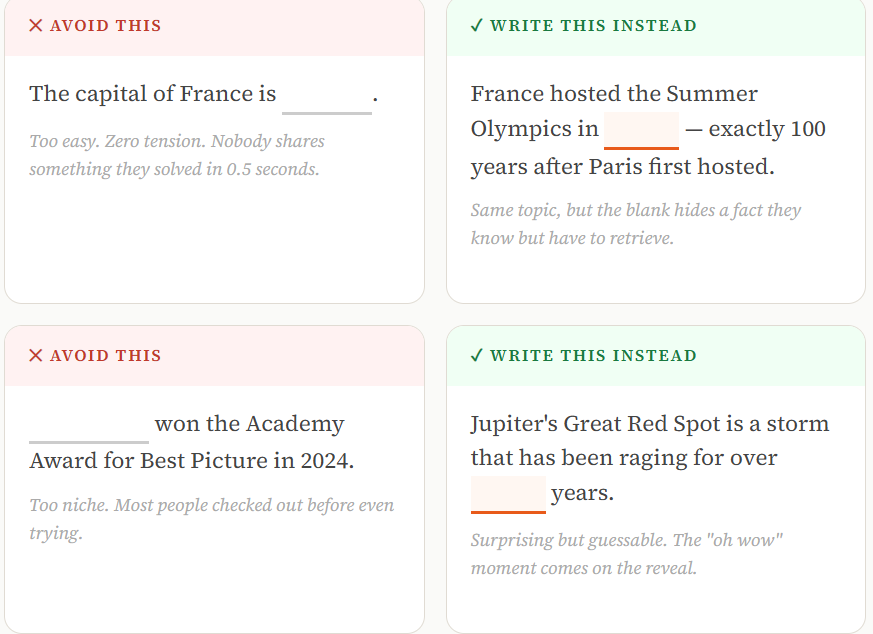
The sweet spot: the answer should feel just out of reach, where people say "oh I should know this" rather than "I have no idea".
The 3 Rules for Writing Good Blanks
- One blank per question. Multiple blanks divide attention. One blank creates one clear target.
- Strong blanks: numbers, proper nouns, years, place names, specific and unambiguous.
- Weak blanks: adjectives, filler words, anything a reader can guess from the sentence structure alone.
- The blank should be specific. Replace vague nouns or general phrases with the most obvious word in the sentence.
- ✓ Year blank works when the date is genuinely surprising: "The Big Mac launched in 1968", most people would guess 1980s.
- ✓ Name/place blank works when the person or location is recognisable but the connection isn't obvious.
- ✕ Too hard when the answer could reasonably be one of ten things, ambiguity kills the payoff.
- Context clues help, but don't reveal. The sentence should make sense without the answer, but not point directly at it.
- Right amount of context: surrounding words narrow the category without giving the exact answer.
- Too much context: every surrounding word points to the same answer, no tension, no engagement.
When fill-in-the-blank is a bad fit: Skip the format if answers have too many valid variations ("name any US president"), if spelling accuracy matters too much for the audience, or if the topic is so niche that most readers can't even attempt a guess. The format needs a fighting chance to feel rewarding.
15+ Fill-in-the-Blank Trivia Questions (Ready to Use)
These are organised by category so you can pick what fits your audience. Each has the blank clearly marked.
Pop Culture & Entertainment
Best for: broad audiences, short-form video, comment-bait posts
Q1. Taylor Swift's The Eras Tour became the first concert tour to gross over _____ billion dollars.
Answer: $1
Q2. Oppenheimer won ___ Academy Awards at the 2024 Oscars. Answer: 7
Q3. Before becoming an actor, Dwayne Johnson was a professional ___.
Answer: Wrestler
Q4. "I am the one who knocks" is a line from the TV show ________.
Answer: Breaking Bad
Science & Nature
Best for: "I know this… wait…" moments, educational content
Q1. Humans share approximately ___% of their DNA with bananas. Answer: 60
Q2. The human body has ___ bones at birth, more than an adult. Answer: 270
Q3. Sound travels ___ times faster in water than in air.
Answer: 4x
History & Geography
Q1. The Berlin Wall fell in ___.
Answer: 1989
Q2. ___ is the only country that is also a continent.
Answer: Australia
Q3. The ancient city of Pompeii was buried by Mount ___ in 79 AD. Answer: Vesuvius
Nostalgia & Brands
Best for: millennial audiences, team events, classroom warm-ups
Q1. Nutella was invented in ___ as a way to stretch limited cocoa supplies after WWII.
Answer: Italy
Q2. The McDonald's Big Mac was introduced nationally in the US in ___.
Answer: 1968
Q3. Red Bull was originally created in and inspired by a drink from ___.
Answer: Thailand
Q4. In the mid-2000s, the tagline shifted to "Because You’re worth it" to be more inclusive, and in 2009, it evolved further to _____________to foster a sense of shared sisterhood.
Answer: Because we’re worth it
Sports
Best for: sports communities, pub quiz rounds, high-engagement comment posts
Q1. LeBron James surpassed ___ to become the NBA's all-time scoring leader in 2023.
Answer: Kareem Abdul-Jabbar
Q2. A standard soccer match is ___ minutes long, excluding stoppage time.
Answer: 90
Q3. The first country to win the FIFA World Cup in 1930 was ___. Answer: Uruguay
Need more questions on a specific theme? You can generate a full set instantly, try the free Typito AI quiz generator here and export your list as a CSV.
Create with Trivia by Typito AI
How to Build Your Fill-in-the-Blank Quiz: A Step-by-Step Workflow with Typito AI
1. Pick a theme your audience cares about
Broad themes get skimmed. Specific themes get played. The more your audience thinks "this was made for me," the more they engage and share.
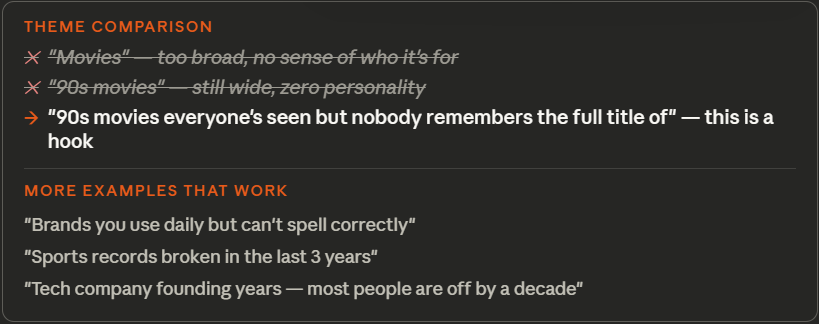
2. Pick your starting point with Trivia by Typito AI
Trivia by Typito AI gives you two ways to start. Both are fast, one gives you more control, the other gets you to a finished video even faster.
Option A: Custom prompt (you write the brief)
Click the custom template tile and write a detailed prompt. Include: topic, format, number of questions, and difficulty level.
"Generate a fill-in-the-blank trivia quiz on 90s pop culture. 10 questions, 7 easy, 3 medium. Use a colourful, fun theme suited for Instagram Reels."
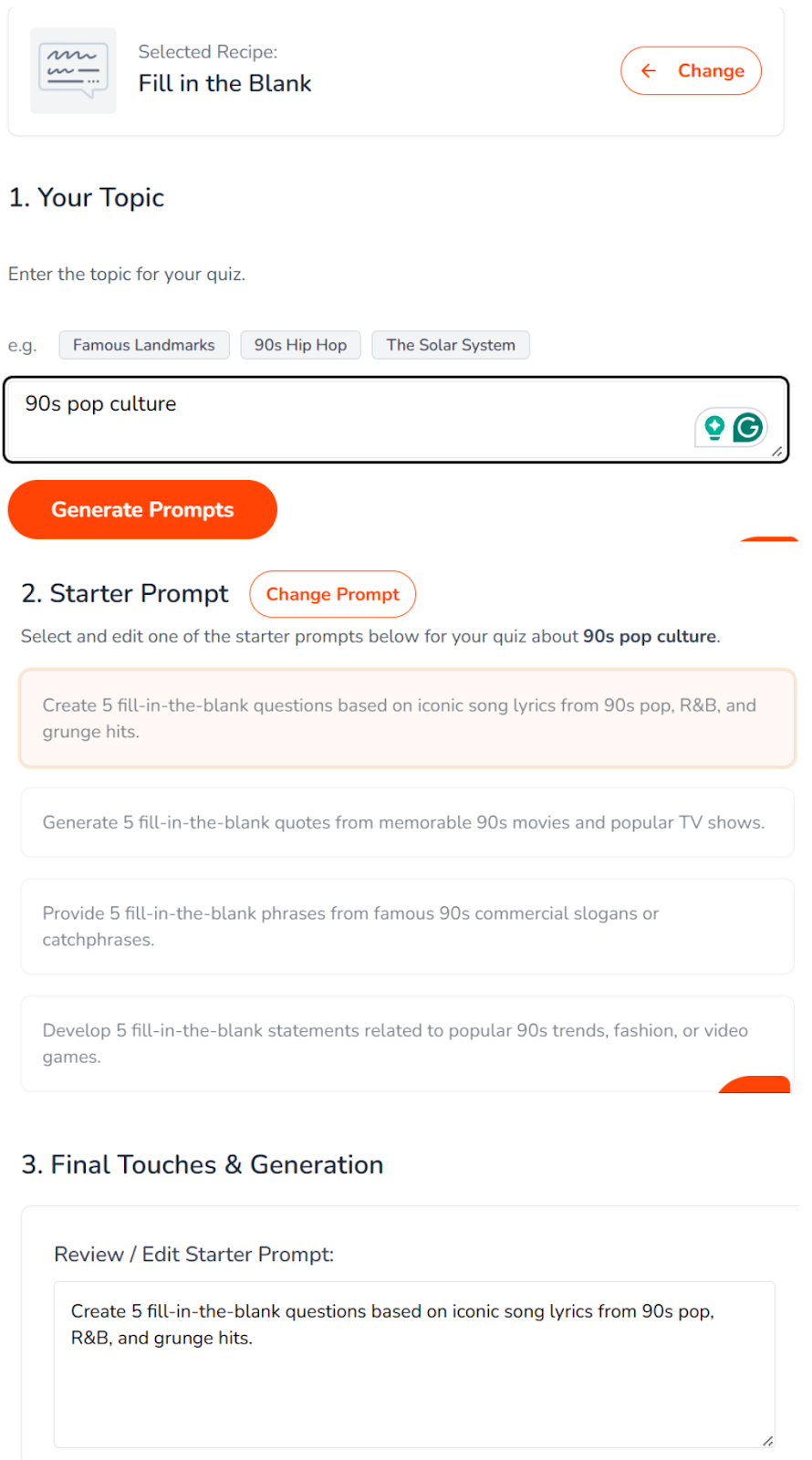
Option B: Pick a recipe (Typito AI writes the prompt)
Browse ready-made quiz templates: Fill-in-the-blanks → describe your topic → Typito builds the full prompt for you → Review, edit if needed, hit generate.
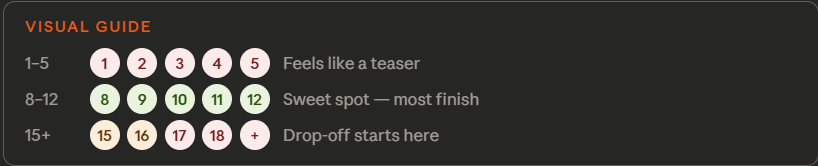
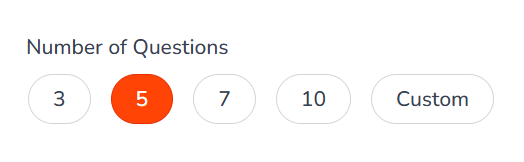
3. Aim for 8–12 questions per round and set the difficulty level
In most cases, 8–12 questions is a strong sweet spot: long enough to feel complete, short enough to finish.
Add a "difficulty arc."
Start with 2–3 easier questions. Build toward harder ones. End on something surprising but knowable.
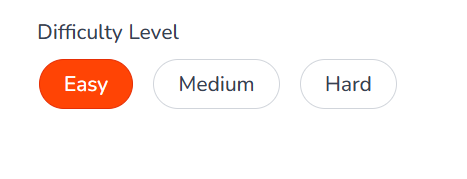
This keeps people going; each correct answer builds momentum.
5. Decide your format: social post, live event, or video
The same questions can work as a text-based Instagram carousel, a live Kahoot-style round, or a short video with a timer counting down. The format changes the experience, but the questions are the foundation.
What changes by format
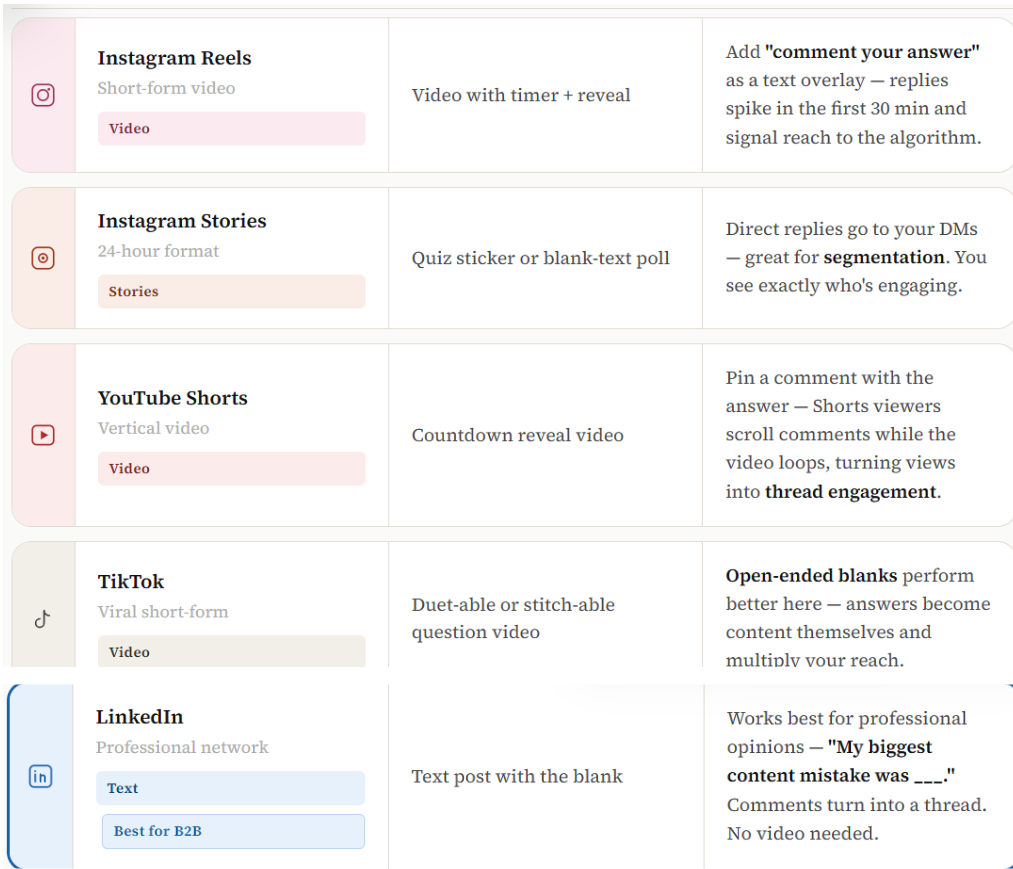
- For comments (social post). Lead with the question, end with "Drop your answer below 👇". Keep the blank obvious enough that casual followers attempt it, save your hardest questions for dedicated trivia followers.
- For Stories. Use the built-in quiz sticker for multiple-choice variations, or the question sticker for open text. Replies come to DMs, great for following up with your most engaged audience.
- For video (Reels/Shorts/TikTok). Show the question for 3–5 seconds, run a visible countdown for 7–10 seconds, then cut to the reveal. The pause is the product, don't rush it.
90s Lyrics Quiz created using Trivia by Typito AI
6. Which Platform Should You Post It On?
The question format works across all short-form platforms, but the execution shifts slightly.
How to Avoid Common Mistakes with Fill-in-the-Blank Trivia
❌Making the blank too obvious: If everyone knows the answer immediately, there is no payoff moment. Add a layer of context that makes your audience work slightly harder for the answer.
❌ Writing for superfans only: Depth without accessibility loses the casual viewer. Casual audiences are the ones who share more, so keep your questions approachable.
❌ Skipping the answer reveal: Always show the answer. The reveal is half the fun, and it encourages people to stick around to check their score, which increases the total time spent on your content.
❌ Posting without a clear prompt: A simple "Fill in the blank 👇" is a necessary CTA. Without it, people just read and keep scrolling. With it, they stop and type.
Ready to turn these questions into a quiz video for Reels, Shorts, or your next team event?
Create one on Trivia by Typito AI
FAQS
Q1. How is fill-in-the-blank trivia different from multiple-choice?
Answer: Multiple-choice relies on recognition, the right answer is somewhere in the list, and the brain just has to find it. Fill-in-the-blank requires active recall: the player has to produce the answer without any hints.
Q2. What topics work best for fill-in-the-blank trivia?
Answer: Topics that blend familiarity with surprising detail work best — pop culture, history, science, food origins, and sports records. The key is choosing facts that people feel they should know but have to retrieve.
Q3. Can a fill-in-the-blank trivia work as a video format?
Answer: Yes, and it performs especially well in short-form video. Show the question with the blank on screen, run a 5–10 second countdown, then reveal the answer with a visual transition.
Q4. How do fill-in-the-blank questions boost social media engagement?
Answer: Fill-in-the-blank questions lower the barrier to respond, there's no long answer required, just a word or phrase. This makes commenting feel effortless.
Q5. How many fill-in-the-blank questions should go in one Reel?
Answer: For a single Reel or Short, one question works best, question on screen, countdown, then reveal, ideally under 15 seconds total. For a carousel or multi-part series, 3–5 questions keeps momentum without losing viewers. If you're building a full quiz round for a live event or classroom, 8–12 questions is the proven sweet spot.
Q6. What topics work best for casual audiences?
Answer: Casual audiences respond best to topics they already have a loose connection with, pop culture records, brand origins, nostalgic product names, geography surprises, and sports firsts.