You have a room (or a social feed) full of language learners. You share a standard vocabulary translation list. Everyone stares blankly.
Standard language drills feel like homework because they treat translation as a chore rather than a game. To drive real engagement, you need bilingual quiz ideas that make the language switch the point.
Whether you are teaching an ESL class or running a multilingual community, participation-first formats are one of the fastest ways to test comprehension and spark real conversation. This guide gives you 20 formats to try, ready-to-use prompts, and tips on how to run them.
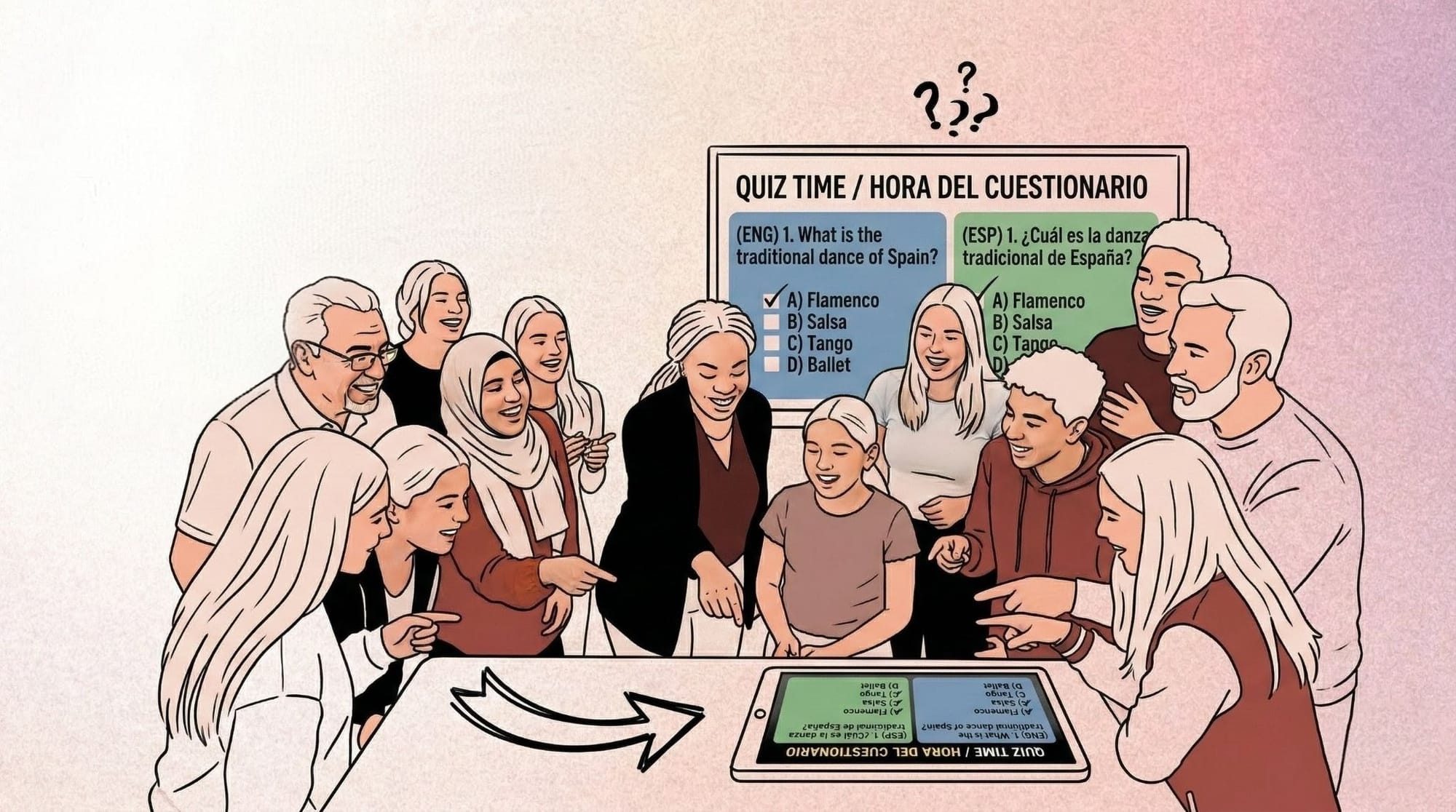
At a glance: 20 ways to run highly engaging bilingual quizzes
Jump to a section:
• How to run a bilingual quiz (quick setup for ESL, immersion, or communities)
• Bilingual quiz ideas by setting: ESL classrooms, immersion programs, and multilingual communities
• How to make bilingual video quizzes readable (no clutter, clean pacing)
• FAQs about bilingual quiz ideas and formats (People Also Ask)
How to Run a Bilingual Quiz (Quick Setup for ESL, Immersion, or Communities)
A dual language quiz is an interactive format that challenges participants to process and respond to prompts using two languages simultaneously.
Translated lists fail because they test passive memory. Participation-first multilingual quiz formats work because they require active listening and context-clue problem-solving.
When the language switch is the challenge, learners lean in. Code-switching becomes a fun participation mechanic rather than a frustrating hurdle.
Tactical Takeaway
Decide your delivery first (live projector, short-form video, or community event), then pick formats that fit. If you're creating video quizzes, a video-first tool can help you turn the same bilingual prompt into a timed round you can post or run in class. Trivia by Typito AI is one option worth exploring.
What makes a multilingual quiz format effective?
Effective bilingual quizzes rely on participation mechanics, so mixed-fluency learners can play without turning it into a translation test.
• They use code-switching to test real comprehension, not rote memory.
• They rely on visual context and listening cues that work across fluency levels.
• They turn the language switch itself into the game mechanic.
Bilingual Quiz Ideas by Setting: ESL Classrooms, Immersion Programs, and Multilingual Communities
Idea 1: Listening Comprehension Quiz Ideas (Audio-First Bilingual Rounds)
Listening-first rounds lead with spoken word or audio clips, making text secondary. This lowers the reading barrier and tests real-time comprehension.
It forces learners to process accents, speed, and context just like they would in a real-world conversation. These work well as warm-ups.
• Audio clip to translation: Play a short native-speaker audio bite and ask participants to translate the core phrase.
• “Say it in…” rapid-fire: Call out a rapid sequence of simple words and point to players to say them in the target language immediately.
• Dialect and accent recognition: Play clips of the same language spoken in different regions (for example, Mexican vs. Castilian Spanish) and have learners identify the origin.
Tactical Takeaway
For short-form video: keep it to one prompt, 8–12 seconds total, using this sequence: Audio → 5–7 second timer → answer reveal.
For classroom: play the clip twice: first for gist, second for details.
How do you use audio in ESL quiz ideas?
You can use audio in ESL quiz ideas by prioritizing listening comprehension over reading. Play short native-speaker clips, conversational snippets, or regional dialect examples, then challenge participants to translate the phrase or identify vocabulary without seeing the written text. Playing each clip twice, once for gist and once for detail, gives every fluency level a fair shot.
Idea 2: Visual Vocabulary Quiz Ideas (Picture + Word Pairing for Mixed-Fluency Groups)
Visual-first rounds work flawlessly regardless of a player's reading fluency level. By connecting an image directly to the target language, you bypass the need to translate back to the native tongue first.
This builds faster cognitive associations and works beautifully for visual platforms.
• Image to correct word: Show a high-quality photo and provide four vocabulary options in the target language.
• Dual-label matching: Display an image and challenge players to match both the Language A and Language B labels to it.
• Emoji-to-translation: Show a string of emojis representing a phrase and ask for the target language translation. See our guide to emoji quiz formats, which walks through how to turn emoji puzzles into short-form video content.
Tactical Takeaway
These formats work well on Stories: use an image background + the Quiz sticker, and keep the prompt short enough to read instantly. If you're publishing as Reels, reveal the second language after the timer so the screen stays readable. For a full breakdown of Story quiz mechanics, Typito's Instagram quiz guide covers exactly how to set up the sticker and track results in real time.
Can visual quizzes help mixed-fluency groups?
Yes, visual quizzes are well-suited to mixed-fluency groups because images provide universal context clues. Beginners can rely on the visual to guess the vocabulary, while advanced learners focus on spelling and precise terminology. Neither group is waiting for the other, which keeps the whole room engaged at the same time.
Idea 3: Cognates and False Friends Quiz Ideas (Fast Confidence + “Aha” Moments)
Cognates can help learners build quick confidence. False friends add a fun difficulty spike, and the “wait, what?” moment is what people remember.
Throwing in “false friends” (words that look identical but mean different things) adds the perfect layer of difficulty.
• True cognate or false friend sorting: Show a word pair and ask players to swipe left for false friend or right for true cognate.
• “Same spelling, different meaning” challenge: Present a word that exists in both languages and ask for its definition in the target language.
• Fill-in-the-blank: Provide a sentence with a missing word and offer bilingual answer options to test context.
Ready-to-use Spanish–English cognate trap table for your next quiz:

Tactical Takeaway
Copy this cognate trap table directly into your next ESL quiz session. Each false friend pair creates a natural “aha” moment that reinforces the correct definition far better than a vocabulary list ever could.
Why are false friends good for quiz ideas for language learners?
False friends are excellent for language learners because they target common translation errors in a low-stakes, gamified way. When a learner gets a false friend question wrong, the surprising correct answer creates a memorable moment that reinforces the actual definition long-term. That surprise is harder to forget than anything on a standard vocabulary list.
Idea 4: Translation Trap Quiz Rounds (Common Mistakes + Idioms)
Translation traps are formats built entirely around common mistranslations and false equivalents. Instead of punishing learners for mistakes, these rounds turn errors into entertaining content.
They highlight the nuances of language that literal translations often miss.
• “Which translation is correct?”: Offer one literal translation and one contextual translation for a culturally loaded phrase. This is exactly the kind of multiple choice format that forces learners to think critically rather than just recall vocabulary.
• Common mistake reveals: Use actual learner errors as the multiple-choice options to see if participants can spot the trap.
• Idiom-to-meaning matching: Challenge players to match a bizarre-sounding foreign idiom to its actual English meaning.
Tactical Takeaway
These work well as short video rounds because the wrong option is often believable. That naturally triggers discussion: people explain why they picked it, and others correct it.
How do you make a vocabulary quiz more engaging?
You make a vocabulary quiz more engaging by focusing on translation traps and cultural idioms rather than simple definitions. Using common mistakes as multiple-choice options creates a natural challenge that surprises learners. When the wrong answer is believable, getting it right feels like a win worth remembering.
Idea 5: Code-Switching Quiz Formats (Bilingual Quiz Questions That Test Real Comprehension)
Code-switching rounds intentionally swap the language mid-question to test cognitive agility. This mirrors how bilingual communities actually speak and engage with each other daily.
It prevents participants from locking into just one linguistic mindset.
• Mid-sentence switch: Start a prompt in English and say, “Complete this sentence in [Language B].”
• Mixed-language questions: Ask a question that blends both languages but requires a single-language answer.
• Underline translation: Provide a full sentence in the native language but only ask them to translate the underlined phrase.
Sample code-switch question set for your next dual language quiz. Copy and use these immediately:
1. “What is the Spanish word for the underlined item: I lost my keys.”
2. “Translate the second half: The weather is beautiful, but it is very cold.”
3. “Complete this proverb in French: C'est la ____.”
4. “Answer in English: A que hora es the meeting?”
5. “Which word is out of place: Apple, Banana, Manzana, Orange.”
Tactical Takeaway
If your group is nervous, share 2–3 sample prompts upfront. If they're confident, keep it a surprise: code-switching works best when people have to react in the moment.
If you want to turn these into a video round, Typito's trivia game maker lets you format and export them as short-form video clips without any editing experience.
What are bilingual quiz questions with code-switching?
Bilingual quiz questions with code-switching intentionally blend two languages within a single prompt. This forces participants to rapidly shift their linguistic context, testing practical comprehension rather than memorized translation. Because it mirrors the way bilingual communities naturally converse, the format feels relevant to learners in a way that single-language drills rarely do.
Idea 6: Cultural Concept Quiz Ideas (Untranslatable Words + Real-World Meaning)
Cultural concept rounds often spark the best discussions because there isn't always a clean 1:1 translation.
They move beyond grammar and test a deeper cultural immersion.
• Culture-specific untranslatable words: Ask players to define concepts like the Portuguese “Saudade” or Danish “Hygge.”
• Number and time formats: Create trivia around how different cultures format dates, tell time, or count.
• Food and color differences: Quiz participants on regional ingredient names or how different languages categorize colors. This format works well for mixed-age groups where visual and cultural context clues give everyone a way in.
Tactical Takeaway
Cultural concept rounds often spark the best discussions because there isn't always a clean 1:1 translation. They perform well in interactive Instagram carousels, community event icebreakers, and Slack group polls.
Why include cultural concepts in language quizzes?
Including cultural concepts in language quizzes tests real-world immersion rather than just textbook vocabulary. It reveals how different cultures perceive time, food, and emotion, giving participants a richer experience that goes beyond right or wrong answers. These rounds tend to generate the most conversation in both classroom and community settings.
How to Make Bilingual Video Quizzes Readable (No Clutter, Clean Pacing)
Bilingual video quizzes work best when you don't show everything at once. Use a simple sequence: show the prompt in Language A, then a timer, then reveal Language B (or the answer), then move on.
If you serve two audiences, duplicate the same quiz and swap the on-screen language so each version stays clean and readable. Trivia by Typito makes this straightforward: duplicate the project, swap the text, and output two audience-ready versions without re-editing. For a deeper look at how AI is reshaping this workflow, see the AI quiz video engagement guide.
Tactical Takeaway
Shoot your quiz host video once, then output two audience-ready versions (Language A and Language B) to double your content output with minimal extra effort.
Where do bilingual video quizzes perform best?
Bilingual video quizzes perform best on short-form, algorithmic platforms like Instagram Reels, YouTube Shorts, and TikTok, where the answer reveal gives viewers a reason to watch to the end. They also work well as interactive warmups when projected in physical classrooms or displayed on interactive smartboards.
FAQs About Bilingual Quiz Ideas and Formats (People Also Ask)
Q1: What is a bilingual quiz?
A: A bilingual quiz is an interactive format that challenges participants using two languages simultaneously. It uses code-switching, translation mechanics, and visual clues to test practical comprehension rather than rote memorization. Because both languages stay active in the same round, learners process meaning in context rather than translating word by word in their heads.
Q2: How do you make a quiz for mixed-fluency groups?
A: You make a quiz for mixed-fluency groups by using visual-first formats and listening rounds. Relying on images and context clues instead of heavy text means both beginners and advanced learners can participate in the same session without the activity feeling too easy for some and too hard for others.
Q3: What formats work best for ESL classrooms?
A: Listening-first challenges, cognate sorting, and translation trap rounds work best for ESL classrooms. These formats lower the barrier to entry, address common mistakes in a way that feels like a game rather than a correction, and encourage active participation instead of passive reading. Visual matching rounds are also a strong option for beginner groups.
Q4: Can bilingual quiz formats work on social media?
A: Yes, bilingual quiz formats work well on social media. Framing them as short-form video challenges with visual timers and answer reveals gives audiences something to react to. False friend rounds and code-switch prompts tend to generate comments because the wrong answer is often believable, which pulls people into the discussion.
Q5: What are good bilingual quiz ideas for Spanish-English learners?
A: Spanish-English learners benefit from formats that play up the natural overlap between the two languages. Cognate rounds build quick confidence, false friends add a surprise element, picture matching keeps the pace fast, and code-switch prompts test real comprehension. These four formats together give you a well-rounded session without needing complex materials.
• Cognate sorting rounds: Spanish and English share thousands of near-identical words, making these great confidence builders.
• False friend challenges: Words like “librería” (bookstore, not library) land well because the surprise sticks.
• Picture matching: Visual prompts remove the need to translate before answering, keeping the pace fast.
• Code-switch prompts: Start a question in English and ask for the answer in Spanish, or vice versa.
• Translation trap rounds built around common Spanish–English idioms and false equivalents.